Saturday, February 18, 2023

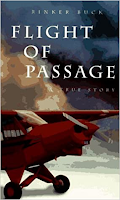
Flight of Passage by Rinker Buck

Flight of Passage by Rinker Buck is a solid book, and the first from the writer of The Oregon Trail and Life on the Mississippi. Published in 1997, it chronicles the flight across the U.S. done by 15-year-old Rinker and his 17-year-old brother Kern Buck, a trip many reporters said was the youngest cross-country trip flown.

Kern was the primary pilot and Rinker the navigator and they in 1996 flew an 85-horsepower Piper Cub from New Jersey to California without a radio. The week-long trip went through Pennsylvania, Ohio, Indiana, Arkansas, Texas, New Mexico, and Arizona before they reached their Orange County destination and the boys' Uncle Jimmy who lived there. 

It's an interesting read about the journey, done with the encouragement of their father Tom Buck, a barnstorming air-show pilot for decades who lost a leg in a plane crash before the birth of the brothers. The book includes great content on the trip, the confidence that grew in the boys through it, including from flying the Guadalupe Pass through the Rockies, and the characters met along the way. It's a really good tale of a time in America and the completion of a fairly herculean task. Buck also details well the dynamic between he and Kern and how they interacted with their larger-than-life father.

Sunday, January 15, 2023

River of the Gods by Candice Millard

River of the Gods by Candice Millard is a solid book subtitled Genius, Courage, and Betrayal in the Search for the Source of the Nile. The book tells the story of Richard Burton and John Speke as the two British explorers searched in Africa to find what feeds the longest river in the world, and then to prove their dissenting opinions.

There was a legend that the source of the Nile was the Mountains of the Moon, a series of peaks, and the Nile has a basin that spans more than a million square miles, and has enabled survival for ancient civilizations. It was known that the Nile made up of both the Blue and White branches, the mystery was the source of the White Nile. 

Burton was the leader of the 1856 first expedition to find the source. He was a master swordsman, impersonated a Muslim to go to Mecca, and was adept at languages, later to become known for his translations. Speke joined the expedition as a surveyor and the men were in Somaliland when their expedition was attacked and men killed. Speke was taken, but managed to escape while suffering eleven stab wounds. Burton was stabbed through his jaw, and the effort abandoned and the men returned home to England. Speke felt that the expedition was not prepared and it Burton's fault.

Despite this start to their relationship, the two set off on a second trip to Africa in search of the source of the White Nile. Joining the expedition was an African named Sidi Mubarak Bombay, who would prove important to their efforts, particularly Speke's. The expedition traveled from the Indian Ocean through East Africa and six months after they left the coast, Burton was almost completely paralyzed with malaria. Burton recovered somewhat and the two men came across Lake Tanganyika, the longest and second deepest freshwater lake in the world. They were the first Europeans to reach the lake, which Arabs had been to for decades. Burton believed the White Nile flowed out of Lake Tanganyika, but Speke had heard of another lake and wanted to go in search of it. Burton agreed to let Speke go without him and Speke and Bombay traveled on to Lake Nyanza, which covers nearly 27,000 square miles, more than twice the size of Lake Tanganyika. Speke immediately felt he had found the source of the Nile, and without his expedition lead, but Burton was skeptical of Speke's claim.

Speke returned on his own to England and immediately made the case for Lake Nyanza, which he renamed Lake Victoria, as the source of the White Nile and painted a picture of Burton as bedridden and unable to make the journey there. Speke received funding from the Royal Geographic Society to return to Africa and hopefully settle the matter of which lake fed the White Nile, with Speke now leading his own expedition. Speke returned to Zanzibar in 1860 and then he and the expedition got to Lake Nyanza, and a waterfall roughly sixteen feet high and nearly a thousand feet wide, with water from the lake going into the river. He didn't complete navigation of the lake or do anything else to definitely prove it the source, but he felt he had seen enough. 

Speke returned to England in 1963 and wasn't very good at proving his assertation about Lake Nyanza over Lake Tanganyika. He didn't have enough evidence to back his claim, and Burton was a much better writer, providing detail that Speke did not. Burton and Speke were to debate the source of the Nile in a Royal Geographic Society talk on Sept 16, 1864, but Speke shot himself prior to it. Nearly a decade after Speke's death, someone else confirmed what Speke had said, Lake Nyanza was the source of the White Nile. It was later found that while Lake Nyanza the principal source, the lake is fed by many smaller rivers and streams, the largest of which is the Kagera River. Speke ultimately was proven correct, but history remembers Burton more, with his books, poems, and translations providing a greater measure of fame than his exploration.

Sooley by John Grisham

Sooley by John Grisham departs from Grisham's most common area of legal thrillers, with this novel tracing the path of Samuel Sooleymon, leaving war-torn South Sudan at 17 to play basketball in the United States.  

It's an entertaining and fast read that tells both a sports story and one about the brutal conflict that the main character left behind in Africa. 

Wednesday, December 28, 2022

Life on the Mississippi by Rinker Buck

Life on the Mississippi by Rinker Buck is an excellent travelogue of sorts, in the same vein of his book The Oregon Trail. In this latest effort, Buck chronicles a 2,000 trip down the Ohio and then into the Mississippi River in a wooden flatboat, the Patience. It's a great read about the people and history of the region joined with the experience Buck had traveling down the rivers.

Flatboats were a common thing in the early 1800s and Buck takes one from the town of Elizabeth, just above Pittsburgh, to New Orleans. He starts out a neophyte and learns how to boat on the river along with the huge commercial vessels, particularly the long barge strings above New Orleans. The book is a great story about an idea that's seen through, and Buck makes the comment that a river journey is an exploration of character. He at times travelled solo and at times with others and he and his crew solve problems along they way. They navigate the rivers, deal with pop-up storms that emerge without warning, force a beaching and then get back in the water, and find fuel when there's many stretches with none by the water. 

Buck also writes about the communities, places like New Madrid, Missouri and Natchez, Mississippi. There were such interesting characters he met along the way, "river rats" who grew up on the Ohio or Mississippi. The rivers, especially the Mississippi, are commercial traffic heavy and to avoid a collision, he deliberated beached the Patience and  relied on the wash from a tugboat wake to get him off the sandbar. 

There's a lot about how the history Buck sees isn't always in the line with the idealized history we like to think of. He chronicles the slave trade and Indian Removal Act of 1830 and the devastating impact it had on lives. Buck also writes about his mother, who passed away not much before he started the trip, and how he would drop her off at the supermarket once weekly for her to do her shopping for an hour. It's a personal and interesting story that's told really well.

Tuesday, December 27, 2022

The Light We Carry by Michelle Obama

The Light We Carry by Michelle Obama is a solid follow up to her book Becoming from 2018. The first is more of an autobiography and this recent effort, subtitled Overcoming in Uncertain Times, notes that it contains habits, practices, attitudes, and beliefs; a series of reflection on things Obama feels to be important and leans on in her life. It's excellent and the chapters that stood out to me as particularly noteworthy are the following:

The Power of Small - Try not to get overwhelmed with the enormity of situations, focus on little things. The example given is knitting, how in doing it, Obama is able to settle an anxious mind. She's putting small next to big. Do something where you can claim a small victory and feel a sense of completion. Go from "it's all too much" to "I've got this." 

Starting Kind - Obama tells the story of her friend who each morning looks at himself in the mirror and says "Heeey, Buddy!" The idea is to take a supportive approach to a day, and it can be extrapolated out to a situation or even a life. She also notes that when a kid walks into a room, they're looking to adults to see if their faces light up when they see them. While we should do that for kids, we can also do that for ourselves. 

Am I seen? - It's hard to go through life feeling different than others, like you don't belong where you are. She notes that it's hard to dream about what we can't see. When you're an "only" in a setting, the only person who is like you, it's hard to feel like you belong. 

My kitchen table - It's important to try to make connections with other people, many of us are lonely. People are missing the sense of belonging with other people. We have to open ourselves up and take a risk to connect with others. She notes telling her daughters "don't do life alone." 

Meet my mom - There's great content in the chapter that stems from Obama's mother, with various maxims she's learned about parenting: 1. Teach your kids to wake themselves up. 2. It isn't about you. Good parents are always working to put themselves out of business. 3. Know what's truly precious. 4. Parent the child you've got. 5. Come home. We will always like you here. 

The armor we wear - Preparation can be an armor. Preparedness becomes a hedge against panic. And panic is what will lead you to disaster. There's also armor which insulates yourself from situations and can be exhausting to keep up, as it prevents you from being your true self. 

Going high - We can consciously choose to lift the level of discourse in a situation, to not let ourselves be pulled down in the muck with others who want us there. Another way to describe it is "tell the truth, do your best by others, keep perspective, stay tough." Obama notes that going high is about doing what it takes to make your work count and your voice heard, "despite the despites."

Saturday, December 03, 2022

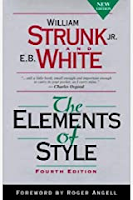
The Elements of Style by William Strunk Jr. and E.B. White

The Elements of Style by William Strunk Jr. and E.B. White was first published in 1959 and over 10 million copies have been sold of this short book with rules of writing. Strunk was a professor of White's and self-published The Elements of Style in 1919. White forty years later expanded on Strunk's rules for the new book.

It's got a lot in less than 90 pages, with the things that stood out noted below:

Form the possessive singular of nouns by adding 's - this is true even if the name ends in s, so "Charles's friend" is correct.

To form the contraction for "it is," write "it's."

In a series of three or more terms with a single conjunction, use a comma after each term except the last - this is a serial, or Oxford, comma.

Do not join independent clauses with a comma - if clauses are grammatically complete, they should be separated by either a semicolon or period. 

Use the active voice. Put statements in positive form.

Use definite, specific, concrete language. Omit needless words. Be clear.

The number of the subject determines the number of the verb - don't combine singular and plural.

A participial phrase at the beginning of a sentence must refer to the grammatical subject.

Express coordinate ideas in similar form - this is the principle of parallel construction.

Place the emphatic words of a sentence at the end.

Avoid split infinitives - write "to inquire diligently" rather than "to diligently inquire."

Write with nouns and verbs, not with adjectives and adverbs (verbs that have "ly" added to the end).

Wednesday, November 30, 2022

The Mosquito Bowl by Buzz Bissinger

The Mosquito Bowl by Buzz Bissinger is a solid book subtitled A Game of Life and Death in World War II. Bissinger chronicles how the 4th and 29th Marine Regiments of the 6th Marine Division played football against each other on Christmas Eve in 1944, with 15 of the 65 players killed while taking Okinawa in 1945.  

The game came about as there so many great college football players in the two regiments. The Marines who played on Guadalcanal included a great roster of college football talent, drawing from former All-Americans, captains from Wisconsin, Brown, and Notre Dame, and nearly twenty who would be drafted or play in the NFL. 

The subsequent Battle of Okinawa was one of the bloodiest of the 20th century, with roughly 3,000 people (American and Japanese troops along with Japanese citizens) dying every day during the eighty-two-day campaign that began on April 1, 1945. The 15 killed at Okinawa was by far the largest number of American athletes to be killed in a single battle, and Bissinger notes in the preface that his father part of the Okinawa invasion, with him also in the 4th Marine Regiment. 

Bissinger chronicles in the book how the loss of American life at Okinawa could have been lessened if better command decisions were made. Also, he covers how the Japanese were so willing to die, either soldiers in battle or civilians killing themselves and their families to avoid what their government told them would be torture at the hands of American troops. Additionally noted was the numerous kamikaze attacks by Japanese pilots, suicide missions against US ships.

It's a solid book and some of the fallen Marines written about were John Jackson McLaughry, David Schreiner, Tony Butkovich, Bob Bauman, and George Murphy. Of these men, the only one of them to survive the war was McLaughry, who died in 2007 at the age of 90.

Sea of Tranquility by Emily St. John Mandel

Sea of Tranquility by Emily St. John Mandel is the sixth novel from Mandel, with two of the prior ones Station Eleven and The Glass Hotel. 

This latest work is a time-travel novel, cutting across centuries with various characters that eventually connect together and while I enjoyed The Glass Hotel more, I did like how Sea of Tranquility includes reference to some of the same characters as from that book.


Saturday, October 29, 2022

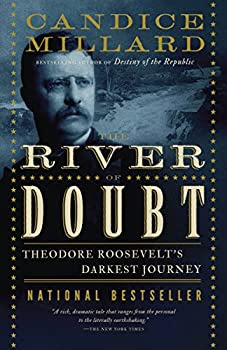
The River of Doubt by Candice Millard

The River of Doubt by Candice Millard is a solid book subtitled Theodore Roosevelt's Darkest Journey. Millard chronicles well the ex-Presidents 1914 voyage down an uncharted tributary of the Amazon River and it was a remarkable tale of a harrowing journey.

The co-commander of the expedition was Colonel Candido Rondon, a man Roosevelt respected greatly, and a hero to Brazilians. The fierce determination of Roosevelt to the mission of the expedition at the cost of his personal safety was striking, along with how dangerous it was. They spent months in the wilderness, dealing with disease and near-starvation. They continually lost their canoes, both ones they brought and ones they made, replacing those lost or not suitable for use on the perilous waters. 

Roosevelt is a fascinating character. He was an enfeebled child, and built his body up through determination, action, and hard work, things that became a constant for through the years. Roosevelt undertook the Amazon journey in part to try to get over a failed presidential bid, with the loss to Woodrow Wilson leaving him doubting himself. He went to Brazil with his son, Kermit, and the expedition was wildly optimistic starting out, with provisions way too heavy and selected for comfort and enjoyment. 

The actual route taken was not the original plan of going down a well-known river. It was Brazil's minister of foreign affairs who proposed the path down the unknown river, knowing that was the sort of thing that would appeal greatly to both Roosevelt and Rondon. Except for the indigenousness tribes, only a few people in history had ever reached the headwaters of what would become named the River of Doubt. The expedition faced grave danger from the local tribes, and Rondon made a point of trying to have relationships with them, even if that meant he or his men be killed. He refused to let his men retaliate against the Indians as he felt forming these relations even more important than exploration. The men often had to portage around rapids, cutting through the jungle and carrying everything. Then the rapids they did try to pass through could be exceedingly dangerous, and led to to the death of one of their crew. Another of their crew killed a fellow member, and then was almost certainly killed by the Cinta Larga Indians as he abandoned the expedition. 

When Roosevelt was on the brink of death from malaria and a bacterial infection as the result of a gash on his leg and considering ending his life to ease the burden on the expedition, it was his desire to see Kermit, one of his sons, survive the voyage that kept him going. They spent six weeks on the river before seeing signs of non-Indian life, they came across- rubber tappers, those who took from the Amazonian rubber tree. Roosevelt lost 55 pounds on the journey, a quarter of his body weight. 

The Winners by Fredrik Backman

The Winners by Fredrik Backman is a really good novel that closes out Backman's three-book series that began with Beartown and then Us Against You. This latest book by Backman provides an excellent capstone to the story on the people in a remote, hockey-mad Swedish community and its rivalry with the neighboring town.

Backman seems to have had the entire story in mind throughout writing the books, as some details in the third hearken back to things in the earlier novels. The Winners is a satisfying and poignant read that covers well struggle, pain, and connection.

Heat 2 by Michael Mann and Meg Gardiner

Heat 2 by Michael Mann and Meg Gardiner is an entertaining novel that follows up on the 1995 movie directed by Mann and starring Al Pacino, Robert De Niro, and Val Kilmer. The book covers years before and after the movie, with backstories on the main characters and showing what occurred following the original story.

Along with being a good book, it's an interesting concept, with it a book follow up to a movie, one that's both a prequel and sequel, and the plan is to turn it into a film.

Saturday, September 17, 2022

Serious Face by Jon Mooallem

Serious Face by Jon Mooallem is an excellent book of essays by someone whose writing I enjoy quite a bit. Mooallem wrote Wild Ones and This is Chance and provides in his latest book thirteen different pieces of writing that he's done, some of which I had some before and some new to me.

Mooallem's writing strikes me as interesting and profound, with his stories often providing unexpected twists and a different look at things than expected. In Serious Face, stories he tells include the following...

"We Have Fire Everywhere" about the fire in Paradise, CA and people fleeing it.

"Why These Instead of Others?" about a twenty-something Mooallem being in Glacier Bay National Park in Alaska and his friend needing Coast Guard rescue after a tree fell on him, causing near-fatal injuries.

"A House at the End of the World" about B.J. Miller, who started in San Francisco the Zen Hospice Project for people with terminal illnesses.

"The Outsiders" about two men helping people as they leave prison, picking them up as part of the Ride Home Program of the Anti-Recidivism Coalition and easing their transition from jail. 

Tracy Flick Can't Win by Tom Perrotta

Tracy Flick Can't Win by Tom Perrotta is an enjoyable novel by the writer of Election, published in 1998 and turned into the Reese Witherspoon-starring movie of the same name. In this decades-later follow up, Perrotta brings us back to Tracy Flick's life and her aspirations. The book is written in an interesting style, with chapters jumping between characters and points of view in the writing and comes to an interesting close. It's a fast and fun read, especially for those familiar with the character of Track Flick that Perrotta wrote some thirty years ago.


Sunday, August 14, 2022

Ruthless Tide by Al Roker

Ruthless Tide by Today show cohost Al Roker is a solid work of nonfiction subtitled The Heroes and Villains of the Johnstown Flood, America's Astonishing Gilded Age Disaster. The book chronicles the man-caused disaster that killed more than 2,200 people in May 1889. Roker notes how the South Fork dam in Pennsylvania giving way unleashed some 20 million tons of water on the areas below it, with a current that traveled 30 miles an hour, with swells as high as 60 feet, down the narrow Conemaugh Valley, 14 miles to Johnstown.  

The earthen dam replaced a previously failed one, with the rebuilding of the natural structure not addressing its deficiencies, on the South Fork Creek that joined into the Little Conemaugh River. The dam created a private lake for the South Fork Fishing and Hunting Club that included as members Andrew Mellon and Andrew Carnegie. It wasn't that nobody thought the dam wasn't safe, but those in charge proclaimed that it was. When water tops an earthen dam and spills over it, the face of the dam is worn away, eventually bringing it down. The structural failure of the dam was it not having a good way to release water, preventing it from reaching the top of the dam. A spillway was built into the dam for that purpose of releasing water, but wasn't enough, and its ability to release water was mitigated by a fishguard built in front of the spillway. It was to keep in the lake prized black bass fish that members went after. In part because of the fishguard, the spillway could only release water passively. 

The region was battered by a heavy storm, with the man-made lake filling up fast and by the time people at the dam in charge of it decided to try to remove the fishguard, it was too late, and the spillway had become clogged by other debris as well. Water went over the dam, cut grooves out of it, and it gave way, emptying the lake over the course of 30 to 45 minutes, leaving acres of mud. Johnstown was first pummeled with water and then fires started, with a stone bridge in Johnstown remaining standing, and exacerbating the death and destruction as it created a funeral pyre of sorts, with people and debris piling up and burning there. 

It's also fascinating reading about the events after the disaster, including Clara Barton, founder of the American Red Cross coming on scene and establishing what the organization was capable of, and has continued to this day. Also, the disaster had effects on the legal system, creating greater liability where it due. While members of the South Fork club and people who ran it largely escaped liability in lawsuits filed, laws were changed to reflect that those who altered a natural environment had greater responsibility for any harm that was caused. 

Happy-Go-Lucky by David Sedaris

 Happy-Go-Lucky by David Sedaris is his first new collection of essays since Calypso was published in 2018. 

It's an entertaining and poignant book that features stories about New York City during covid lockdown, time with his partner Hugh, and the death of his father. 

Sunday, July 24, 2022

Funny Farm by Laurie Zaleski

Funny Farm by Laurie Zaleski is a well-written, interesting, and heartwarming memoir subtitled My Unexpected Life with 600 Rescue Animals. She owns and runs the Funny Farm Animal Rescue in New Jersey and tells in the book the story of her life from a young age interspersed with stories of animals on the farm.

Zaleski grew up under very different circumstances that most, with her mother at the age of 26 leaving her abusive husband and taking Zaleski and her two siblings to scrape out a living in a rented shack in the woods. Her mom, Annie McNulty, was persistent and resourceful, taking on whatever work she could get in order to have food. She also brought home animals from her job cleaning cages at the local Animal Control. The family had little money, but over time would have in and around their house animals including dogs, cats, chickens, roosters, geese, raccoons, goats, sheep, pigs, and a horse. 

While her mother was a good and kind person, caring for animals in need and raising her children well even with them having no money, Zaleski’s father was a horrible one, almost certainly killing their dogs and horse as an act of revenge for his family leaving.

Zaleski is a good writer and it’s a nice story she tells, one of grit and care. The stories of her animals at the Funny Farm rescue are great ones, including those of oddball animal friendships, with Hope the blind kitten and Jello, her seeing eye duck, Lorenzo the llama and his donkey friend Jethro, and Yogi the steer and his alpaca friend Cooper. Also wonderful are the stories of first Chucky and then Tucker, dogs with megaesophagus. It was difficult for them to keep food down so they had to sit upright in a “Bailey Chair” that induces food to slide down and actually provide nutrients to the body, rather than being immediately thrown up.

She writes how kids see the rescue animals, during school assemblies and at the farm, and hear their stories of both getting along with others different than them and helping others with infirmities. It’s a great message and also compelling reading about inner-city kids being exposed to animals and a different way of life.

Monday, July 11, 2022

The Children's Blizzard by David Laskin

The Children's Blizzard by David Laskin is a solid work of nonfiction about the storm that hit the Midwest on Thursday January 12, 1888. It was known as the "Schoolchildren's Blizzard" because many of the dead were caught outside after leaving school, with estimates of the tool between 250 and 500 people.

Laskin notes how the storm came across the prairie through the Dakota Territory and into the new state of Nebraska. It caused the temperature to drop 18 degrees Fahrenheit in 3 minutes and couldn't really be said to be snowing, it was fast blowing crystals attacking people's exposed skin and flimsy clothing. In the region that would soon become South Dakota, there were deaths from the storm in 32 of the 34 counties east of the Mississippi River. Laskin provides fascinating writing on how for someone coming out of extreme cold exposure, abrupt movement can bring about cardiac arrest and death as the cold heart extremely sensitive. So many things came together for bad that day, ideal conditions for a huge storm, people exposed to it in what started as the first beautiful day in a while, and a failure of weather forecasting, done by the Signal Office, part of the U.S. Army.

The area the brunt of the storm was felt in was populated by immigrants, many German or Scandinavian. They were enticed by the Homestead Act, where the U.S. government gave adults 160 acres in exchange for five years of farming, and found a hard life, one that required their children to do a tremendous amount of labor to try to help the family scratch out a living. Along the way they encountered extreme weather, insects in the form of enormous grasshopper swarms that would destroy crops, fires that would devastate their fields, and solid ground that often wasn't conducive to farming.

In writing about the storm of 1888, Laskin provides fascinating content about the physics of weather and about the people, he tells so many interesting stories of schoolteachers making decisions of whether to send their students out in the conditions or keeping them in, or trying to take them to safety. About the stories Laskin told of people dying, he noted in the afterword using poetic license to describe what someone might have thought, said, or did prior to dying, with his choices based on interviews or accounts of people's personality. It seemed this somewhat detracted from the effort as the book contains in some parts text that it didn't seem possible to actually be known. Laskin also covers how in the aftermath of the storm, newspapers had their stories with more of a heroic bent to them, in part due to pressures to not dissuade people from moving to the region and stemming the population growth there, something which happened anyways. Drought came several years later to the area, then a financial panic and depression that caused those who had borrowed against their homesteads to go bankrupt. By the late 1890s, over 60% of the pioneer families had abandoned their homesteads. It was hard living in a region, with one of the more calamitous events to strike it chronicled well.

Where the Crawdads Sing by Delia Owens

Where the Crawdads Sing by Delia Owens is a well written and interesting novel that's a surprise mega-success. Its got over 12 million copies sold as of January 2022 and came out in the summer of 2018 to little advance acclaim, written by a first-time novelist. Owens is a retired wildlife biologist in her 70s, with her previous works nonfiction accounts of the decades she spent in Botswana and Zambia.

The book is set in the marshes of North Carolina between 1952 and 1969 and covers the story of a girl born exceedingly poor, living apart from society in a shack outside of town and forced to live on her own after first her mother, then siblings, and eventually father exit her life, leaving her to fend for herself from the age of ten. Her life and fleeting interactions with other people is chronicled by Owens and it's an engrossing story, blending together family trauma, natural history, romance, and mystery, and has been made into a movie executive produced by Reese Witherspoon.

The book has so many elements I love, it's good writing from Owens, about someone with a life completely different than I'm familiar with as she's living on her own in a fringe society of people eking out a life in the swamps, with the natural world heavily featured, and written by someone who lived in Africa among animals and who wrote an unexpected bestseller. It's great stuff and I enjoyed it quite a bit.

Thursday, June 30, 2022

Africa in My Soul by Cheryl King Duvall

Africa in My Soul by Cheryl King Duvall is a good book subtitled Memoir of a Childhood Interrupted.

Duvall was ten when her parents went to become missionaries in Africa, leaving behind in Georgia her fifteen year old sister and taking she and her two younger siblings to Nigeria. Her sister had to stay back and live with strangers, not because there wasn't a religious school she could attend in Africa, but because it wasn't the right type of religious school.

Duvall in Africa was stuck in mission boarding schools for 9 months of the year, under the care of people who forced the missionary kids to refer to them as auntie or uncle, and was the victim of an episode of sexual abuse by a doctor at the mission. Her story shows awful it is when parents think they're making sacrifices, in this case to become missionaries, but really they're making them on their children's behalf. 

The book shows the hardships Duvall faced in Africa, and also how the continent an amazing place, one full of beauty and also people who turned on one another, with there a civil war while she in Nigeria.

Saturday, June 18, 2022

Love is the Killer App by Tim Sanders

Love is the Killer App by Tim Sanders is a solid read from 2002 with the subtitle How to Win Business and Influence Friends. The idea put forth by Sanders is to be what he calls a lovecat, someone who gives freely to others, and the book is organized into three sections: your knowledge, your network, and your compassion. 

About your knowledge, Sanders writes that to be able to share information, you first have to acquire it. It's about books, reading lots of books, having a system to remember what you've read, and then passing on details to those it can help. 

About your network, Sanders notes to keep track of your contacts, write down details about the people you interact with so that you remember. Collect relationships and then connect people with one another, follow up and make introductions. 

About your compassion, Sanders quotes a definition of love as being the selfless promotion and growth of the other. He writes of the need to care, be human, and tell people things that matter which you may otherwise guard. Also highlighted is that compassion comes back; it refills those who give it.

Going back to the section on knowledge, Sanders notes to let reading be the thing that propels you, it doesn't require genius, and then you learn things, share them with your network, build out that network and help others. It's a good read from Sanders and some of the books he recommends are the following:

Net Gain by John Hagel and Arthur Armstrong

Information Masters by John McKean

The Brand Mindset by Duane Knapp

The Experience Economy by Joseph Pine and James Gilmore

Permission Marketing by Seth Godin

Customer Capitalism by Sandra Vandermerwe

The Innovator's Dilemma by Clayton Christensen

The Anatomy of Buzz by Emanuel Rosen

Getting in Your Customer's Head by Kevin Davis

Toward a Psychology of Being by Abraham Maslow

Leading the Revolution by Gary Hamel

Building Brandwith by Sergio Zyman and Scott Miller

Race for the World by Lowell Bryan, Jeremy Oppenheim, Wilhelm Rall, and Jane Fraser

Differentiate or Die by Jack Trout and Steve Rivkin

The Profit Zone by Adrian Slywotzky

Making it Happen by Mackenzie Kyle

The Circle of Innovation by Tom Peters

New Rules for the New Economy by Kevin Kelly