Sunday, December 31, 2023

Going Infinite by Michael Lewis

Going Infinite by Michael Lewis is a compelling book about Sam Bankman-Fried, the now-convicted founder of FTX and Alameda Research. Lewis first heard of him at the end of 2021, when Sam took FTX to $1B in revenue, up from $100M in 2020, and $20M in 2019. The book largely chronicles his rise, with the end covering his rapid fall. It felt like a satisfying conclusion was lacking, largely because it not clear where the money went. 

Lewis covers how Sam went to MIT and interned and then was hired at Jane Street Capital. It's a high-frequency trading firm and it was fascinating reading about the interview process there, one centered around probability and chance. It was to determine how someone operates in an environment of uncertainty, how do they go about making decisions? The questions were all mental math around odds, like what amount of money would someone trade for a possibility of a larger amount of money. It was testing someone's relationship to information. 

Lewis covers how these type of calculations fit Sam perfectly and his decisions involved an expected value calculation. He would at the spur of the moment change a plan based on a new calculation he made of how he wanted to spend his time. 

Sam loved things where there was only partial knowledge of a situation, and when he discovered crypto trading, he found it a perfect fit for him. Sam quit his job in 2017 to start Alameda Research as a crypto trading firm and by November 2018, Alameda Researched traded more than 5% of the total volume of crypto markets. He then founded FTX as a new company, a crypto exchange, and as this was occurring, Sam was living in Asia, and then moved to the Bahamas. In late October 2022, it all came crashing down, triggered by a crypto crisis. On November 11, FTX went into bankruptcy in the United States, as FTX should have been holding some $10B in customer deposits, but only had a fraction of that.

It's a shame that Sam flamed out given his donations to various causes, including fighting climate change and promoting democratic principles, including how he toyed with the idea of paying Donald Trump billions to not run again for President. The book closes with the bankruptcy efforts to try to figure out what happened with the money, before the trial of Sam, and it's an interesting read.

Thursday, December 28, 2023

Gallop Toward the Sun by Peter Stark

Gallop Toward the Sun by Peter Stark is a solid book subtitled Tecumseh and William Henry Harrison's Struggle for the Destiny of a Nation. Stark tells the story of the Indian leader and his efforts to prevent the encroachment of white settlers onto Indian lands, in opposition to Harrison who was attempting to expand American lands further and further west.

Harrison was appointed governor of the Indiana Territory, some 260,000 square miles, in 1800, briefly serving under John Adams as President, followed by Thomas Jefferson, then James Madison. Jefferson relentlessly pursued land acquisition, and was in office for the Louisiana Purchase, where France under Napoleon sold the Louisiana Territory for $15M, or half a billion acres at roughly three cents each. 

Harrison pushed to increase the U.S. footprint, wanting to get the Indiana Territory to 60,000 residents so it could get statehood, with he perhaps a Senator. James Madison became President in 1809 and wanted land acquisition done without conflict, but would rely on Harrison's promises of fairness in dealing with the tribes. Harrison would appease the White House with his statements, but then do whatever it took to get more land, getting tribes to sign agreements that harmed other tribes. 

Tecumseh was a Shawnee warrior and worked to bring together various tribes, attempting to unite them into an alliance against American expansion. There was first negotiations and then armed conflict between Americans and tribes led by Tecumseh. Eventually came the War of 1812 between the U.S. and Britain, with Harrison taking a military command and Tecumseh fighting on the side of the British in an effort to maintain Indian lands. Tecumseh was killed as he advanced on someone he believed to be Harrison, and the territory governor ultimately realized his goal of national office, becoming the (short-lived) ninth U.S. President.

The book is an interesting story of two opposing forces and Stark quotes historian Colin Calloway who described the contest between the leaders as "a war for America's heart and soul."

Thursday, December 07, 2023

Hidden Potential by Adam Grant

Hidden Potential by Adam Grant is an interesting book subtitled The Science of Achieving Greater Things and split into three sections, with three chapters in each:

Skills of Character - getting better at through character skills

Chapter 1: Creatures of Discomfort - embrace awkwardness and do things, don't be afraid of being embarrassed 

Chapter 2: Human Sponges - rather than asking for feedback, it's better to ask for advice on how to improve at something, asking what you can do better elicits more specific suggestions and input that can help you

Chapter 3: The Imperfectionists - it's not a perfect world, it's ok to make mistakes, or deal with things as they are and appreciate flaws, judge on your best moments, not your worst, ask multiple you trust people to score the work you do


Structures for Motivation - get the scaffolding to help you when you need it

Chapter 4: Transforming the Daily Grind - make practice fun, enjoy the time you spend on things, play at things, make a game out of drills

Chapter 5: Getting Unstuck - try different things, be willing to start over or go backwards in an effort, take a detour and spend time on something else to get unstuck or reach a goal

Chapter 6: Defying Gravity - work together to accomplish something, the tutor effect... be a teacher of something at the same time you're a student, encouraging others helps us find our own motivation, making progress can be about simply bouncing back and not quitting


Systems of Opportunity - open doors for people underrated or overlooked

Chapter 7: Every Child Gets Ahead - Finland's educational system has created a culture of opportunity that assumes everyone can excel, just some might need more personalized support

Chapter 8: Mining for Gold - the 2010 rescue of 33 men from a Chilean mine, with ideas of how to keep them alive and then get them to safety sourced from a wide spectrum of people, the best leaders have prosocial skills and are often the best listeners

Chapter 9: Diamonds in the Rough - astronaut Jose Hernandez and his path to getting accepted by NASA into the program, setting up people for success in interviews by helping them be comfortable and talk about their interests and passions


It's an excellent read and Grant in the epilogue tells about interviewing for admission to Harvard, getting in and then once there, turning down the remedial writing course that he was pointed to and getting an A in the regular course, which led to his interest in psychology and writing. Grant closes the book with "success is more than reaching our goals - it's living our values. There's no higher value than aspiring to be better tomorrow than we are today. There's no greater accomplishment than unleashing our hidden potential."

Wednesday, November 29, 2023

The Last Politician by Franklin Foer

The Last Politician by Franklin Foer is a really good book subtitled Inside Joe Biden's White House and the Struggle for America's Future. Foer provides great writing about Biden and his first two years as President.

The book starts with the inauguration, 14 days after the storming of the Capitol, and then passage of the American Rescue Plan stemming from the pandemic. After this is detailed production of the Covid vaccine and its rollout, something that had to have the plan created for it as the Trump Administration apparently didn’t have one. Also written about is the withdrawal from Afghanistan, an incredibly difficult task that was hit at the end by a suicide bomber, resulting in the loss of 13 American soldiers. 

Legislation that Biden fought successfully to have passed included the Inflation Reduction Act, a significant investment in alternative energy, and CHIPS Act and infrastructure bill investing in technology and manufacturing. Also during these two years was the backing of Ukraine with Russia’s invasion, while avoiding direct conflict between the U.S. and Russia, and management of the relationship with China. 

Foer shows himself to be a wordsmith in the book and writes of the tasks Biden faced in his first two years in office. He had up times and down times, with both his leadership propelling causes forward and gaffes holding them back, and in his first two years in office accomplished much for the country and beyond.

Saturday, November 04, 2023

Breathless by David Quammen

Breathless by David Quammen is a thorough work of nonfiction subtitled The Scientific Race to Defeat a Deadly Virus. The book jacket notes that it "traces the journey of SARS-CoV-2 through the human population, as seen by the scientists who study its genome, its ever-changing nature, the much-argued question of its origin, and its capacity to kill us." 

Quammen provides a detailed investigation of Covid-19 through his interviews with close to 100 experts and while it can be a heavy read at times, it's a well-done book. He details where the argument for the virus being lab-made came from, and how the evidence shows that to be unlikely. 

It's fascinating reading of how scientists in late December started to hear about patients in Wuhan, most of them having connection to the Huanan Seafood Wholesale Market, with an unknown cause of pneumonia. By January 19, 2020, the Wuhan CDC noted a case count of 198 and were calling the disease a novel-coronavirus-infected pneumonia. At this time, the virus had already spread beyond the country and the thing that scared scientists perhaps the most about the new virus was that people could have and transmit it without showing symptoms themselves. 

It was fascinating reading of the work that went into understanding the novel coronavirus and interesting information about how the virus spreads between both human and animal populations (with spillover occurring when it crosses between them). This makes the virus much more difficult to eradicate, and increases the mutations and variants that occur in it. Quammen notes that transmission to humans likely occurred in the market, from an animal source, and then spread from there with Wuhan a hub for travelers. He also covers how the Chinese government restricted access to information, likely both because restricting access to information is what they do, and from their experience with another coronavirus, SARS-CoV in 2003 that originated in China. Quammen also discusses the fallacy of herd immunity. especially with something that travels between humans and animals, and the rapid development of mRNA covid vaccines. Also noted is Dr. Peter Hotez and the effort to create non-mRNA vaccines, recombinant-protein methodology-built ones that are cheaper, more stable, and can be taken orally or as a nasal squirt.

The Midcoast by Adam White

 The Midcoast by Adam White is a novel set on the coast of Maine, with White telling a suspenseful story of families involved in drug running in a small community. There's some compelling writing about the choices people make and social classes and the juxtaposition between wealth and just getting by.


Why We Love Baseball by Joe Posnanski

Why We Love Baseball by Joe Posnanski is an entertaining book subtitled A History in 50 Moments. Posnanski covers the moments in baseball that stuck with him, ranging from the well-known moments of triumph to the simply interesting. It's noted in the introduction that there's actually 108 moments covered in the book and some of those that stood out are listed below:

- Five unlikely homers - including pitcher Bartolo Colon homering in 2016
- "There's no crying in baseball" from A League of Their Own
- The pine tar homer by George Brett in 1983 during a Royals-Yankees game
- The Bo throw by Bo Jackson vs. the Mariners in 1989
- A home run off Jose Canseco's head in 1993
- The Edgar Martinez double scoring Ken Griffrey Jr. for the Mariners against the Yankees in game 5 of the ALDS
- The 1947 embrace of Jackie Robinson by Pee Wee Reese (which may not have been an actual embrace, but likely still was a big moment)
- Joe Carter of the Blue Jays homering against Mitch Williams of the Phillies to win the 1993 World Series
- The bat flip by Jose Bautista in the 2015 Blue Jays-Rangers playoff game
- Vin Scully's call of the Sandy Koufax perfect game September 9, 1965
- One-handed pitcher Jim Abbott throws a no-hitter September 4, 1993
- Dee Strange-Gordon homers in September 2016, the first Marlins game after the death of Jose Fernandez
- Cal Ripken in 1995 passing Lou Gehrig's streak of 2,130 consecutive games played
- The last .400 season in 1941, with Ted Williams going into the final day at .3995 and then going 6-8 in the final day doubleheader, taking his average to .406
- Armando Galarraga throwing a near-perfect game in 2010, taken away by Jim Joyce blowing the call on what should have been the final out, and Galarraga graciously accepting his heartfelt apology
- David Ortiz in 2013 speaking to the crowd at Fenway Park after the Boston Marathon bombing and saying "this is our fucking city. And nobody's gonna dictate our freedom. Stay strong."
- Kirk Gibson of the Dodgers homering off Dennis Eckersley of the A's to win game one of the 1998 World Series, with Vin Scully simply saying "high fly ball into right field... she is GONE!"
- The speech by Jason Hayward during the 9th inning rain delay of the 2016 World Series 7th game between the Cubs and Indians, helping end the Cubs long run of failure

Friday, October 27, 2023

Graveyard of the Pacific by Randall Sullivan

Graveyard of the Pacific by Randall Sullivan is an interesting book subtitled Shipwreck and Survival on America's Deadliest Waterway. The book is about the Columbia River Bar off the coast of Oregon, where the massive Columbia River flows into the Pacific Ocean, creating frenzied water conditions that have claimed over two thousand ships and to this day remains an extremely dangerous area.

Sullivan in the book tells stories from the Columbia River Bar, and weaves in the story of his life as he and his friend Ray Thomas (who had a similarly troubled childhood with a domineering father) set out to cross the bar via a trimaran two-person kayak. 

The book has a solid blend of personal narrative with history about a fascinating area, the calamities that occurred there, and the people who lived and worked around it. Among other stories, Sullivan covered the Tonquin, a ship sent by John Jacob Astor and written about in Peter Stark's book, Astoria. The parts about shipwrecks are great, but equally as interesting are those about people (especially the Coast Guard, but also the Columbia River Bar Pilots) putting their lives in danger to rescue others and to help get boats successfully through the dangerous waterway.

Thursday, October 26, 2023

The Underworld by Susan Casey

The Underworld by Susan Casey is a wonderful book on deep sea exploration, following other books Casey has written about the ocean, including The Devil’s Teeth and The Wave.

She notes that the deep ocean is the waters below 200 meters, approximately six hundred feet, and has a fascination with the deepest parts of the ocean, including the twilight zone region described as being from six hundred to thirty-three hundred feet deep, midnight zone from thirty-three hundred to ten thousand, abyssal zone from ten thousand to twenty thousand, and hadal zone from twenty thousand to thirty-six thousand feet deep. The deepest part of the ocean is Challenger Deep, at 35,786 feet within the Mariana Trench. 

Rather than being barren as was once thought, the deep ocean is alive with fantastic creatures, bacteria, and microbes that are the source of life, whose understanding yields new medicines and treatments for disease. Also, the deep ocean buffers carbon and regulates conditions on earth.

Covered in the book are deep sea submersibles, the ships that a very few people have taken to the bottoms of the ocean. In 2012, James Cameron touched down at the bottom of Challenger Deep, the third person to ever reach that point, and Casey writes heavily about billionaire explorer Victor Vescovo. He in 2018 commissioned a submersible, the Limiting Factor, that he could pilot to the depths of the ocean and set out to dive to the deepest points in all five ocean basins. The effort was known as the Five Deeps and carried a roughly 50-million-dollar price tag. Vescovo has also been to the top of the seven summits, to both poles, and to space.

It’s a great story of eclectic and fascinating people along with amazing geography. Casey was to go in a submersible down to explore Lo’ihi, the next Hawaiian volcano, thirteen thousand feet tall, and a mile below the surface, which should poke out of the water in perhaps a hundred thousand years. She details how we have to understand the deep ocean, its geology, and the life there to fully understand our world, including its plate tectonics and accompanying earthquakes. Casey covers hydrothermal vents, the giant squid discovered in 2012, and the Lost City, an underwater area of more than thirty white pinnacles and spectacular formations, formed by chemical reactions between mantle rock and seawater.

Not unexpectedly, there is detail about people wanting to effectively destroy the ecosystem of the ocean, by deep-sea mining nodules containing metals. Mining is controlled by the International Seabed Authority (ISA), an organization noted as akin to oil executives deciding on forest ecology. Petitioning the ISA on behalf of energy companies is the country of Nauru, containing some 11,000 people, with leaders who have stripped their land bare and now seem to want to do the same to the ocean. There is also a chapter about shipwrecks and treasure, specifically the San Jose, as written about in The Wager by David Grann. She includes mention of the nonprofit OceanX started by Ray Dalio, the marine research group Inkfish, and the BBC series Blue Planet II. The book is a great narrative about Casey's love of the deep ocean and desire to see it. 

Wednesday, September 13, 2023

This Is How It Always Is by Laurie Frankel

This Is How It Always Is by Laurie Frankel is an excellent novel with characters that stick with you long after reading the book. Frankel tells the story of the Walsh-Adams family - Rosie and Penn and their kids Roo, Rigel, Orion, Ben, and Claude, the last born. 

Claude as he was getting ready to start elementary school was more and more drawn to dresses and things traditionally favored by girls, and eventually became known as their daughter, Poppy. It's an emotional tale of Rosie and Penn, and their other kids as they work to support and do right by the youngest member of the family. 

Frankel provides a beautifully written story that stretches from Wisconsin to Seattle to Thailand. It's filled with great pain, great love, and then the Buddhist concept of a middle way of living, one betwixt opposites.

Sunday, September 10, 2023

The Heartbeat of the Wild by David Quammen

The Heartbeat of the Wild by David Quammen is a solid book from someone with a two-decade career as a National Geographic magazine science writer. It's subtitled Dispatches from Landscapes of Wonder, Peril, and Hope and contains twenty-one different accounts of his travels, with stories including:

Three different pieces on walking with ecologist Michael Fay on his Megatransect journey across Central Africa. He traveled 2,000 miles on foot over 15 months, going through often heavily forested areas to Gabon on the African coast. Fay along the way cataloged the ecosystems he came across.

An account of time on the Kamchatka Peninsula in far Eastern Russia, an isolated area that went into disrepair with the collapse of the Soviet Union, with salmon fishing an important part of the economy. 

Two stories about C-Boy, a Serengeti lion that escaped death after being attacked as a youth by a pack of lions dubbed the Killers. C-Boy lived to old age, with an image of him on the cover of the book.

A story about the Ebola virus, the impact it has had on Africa (both people and animals) and search by scientists for the origin of Ebola outbreaks and the reservoir host of the disease. 

An overview of the Okavango Delta, an area in Botswana critical to both the ecology and economy of the country, and how the Delta needs water that flows from elsewhere, particularly Angola, to survive.

A chronicle of what tech entrepreneur and philanthropist Greg Carr has done in Africa, helping create parks and reinvigorate wildlife as well as educate and empower young African girls. 

The tale of Doug Thompkins and Kristine McDivitt Thompkins and their conservation efforts in Chile and Argentina, started by each and continued by Kristine following Doug's death from hypothermia after his kayak capsized in a Chilean lake.

Saturday, August 26, 2023

The Book of Charlie by David Von Drehle

The Book of Charlie by David Von Drehle is a solid book subtitled Wisdom From the Remarkable American Life of a 109-year-old Man. Von Drehle recounts the tale of his Kansas City neighbor Charles Herbert White. 

It's an interesting story of someone who grew up in an entirely different time. His father was killed in an elevator accident when White a young child, forcing him to develop the resilience he would carry with him for another century. 

Von Drehle wrote about his friend and the idea friend and the idea of Stoicism, nothing that "people think it has to do with not having feelings or not caring about the world. But what it teaches is, we can only control our own selves, our own will, decisions and actions. We don’t control people; we don’t control the world; we don’t control the future. I think Charlie finally drove home that wisdom for me.” It was fascinating to think about what White lived through, including two World Wars.

The Art Thief by Michael Finkel

The Art Thief by Michael Finkel is a solid work of nonfiction subtitled A True Story of Love, Crime, and a Dangerous Obsession. Finkel tells the story of StĂ©phane Breitwieser, who carried out more than 200 art heists across Europe over a 10-year-period. He stole, usually with the help of his girlfriend, Anne-Catherine Kleinklaus, more than three hundred works of art, worth an estimated $2B. 

Singular in the world of art thieves, Breitwieser stole not to then sell the pieces, but rather to just keep and look at them. He displayed the work where he lived with Kleinklaus, in the attic of his mother's house. 

It is interesting reading of the audaciousness of many of the heists and Breitwieser's self-professed love of art is at first somewhat endearing, but his view of himself as a liberator of art is impossible to reconcile with what eventually happens to the pieces. It felt inevitable that things would end poorly, regardless of whether Breitwieser expected or intended them to, making him come across less as sympathetic and more as someone who caused great harm.

Saturday, August 12, 2023

Now Is Not the Time to Panic by Kevin Wilson

Now Is Not the Time to Panic by Kevin Wilson is an entertaining novel by the author of the excellent book Nothing to See Here

In his latest work, Wilson tells the story of Frankie and Zeke, teenagers in the fictional town of Coalfield, TN who unwittingly start a local panic that becomes national news. They created and surreptitiously put up with a poster with Zeke's drawings and sixteen-year-old Frankie's phrase "The edge is a shantytown filled with gold seekers. We are fugitives, the law is skinny with hunger for us."

The book tells of them putting up hundreds of posters, and then people copycatted them, putting up scores more, with many in the population latching on to fanciful ideas of the posters having been created by a satanic cult looking to bring harm to the town. Interested people descended on Coalfield in such numbers that the town for a period of time was shut off from outside visitors to try to maintain order. The poster was then recreated and distributed outside of Coalfield, entering the popular imagination and discourse, featured on 20/20 and mentioned on Saturday Night Live.

Wilson tells about the summer this all took place, and then what happened twenty years later with Frankie (who became a popular novelist), Zeke, and the creation story of the poster. It's a good tale from Wilson that deals in friendship, adolescence, art, hysteria, and secrets.

Sunday, July 16, 2023

The Time Has Come by Will Leitch

The Time Has Come by Will Leitch, who also wrote the novel How Lucky, is a short and interesting novel.

This latest work of fiction from Leitch is also set in Athens, Georgia, and tells a story set around Lindbergh’s Pharmacy, run now by Theo Lindbergh after he took it over following the death of his father, Jack.

The book covers various characters separately and then brings them together at the end, with the principles Theo, Daphne (a nurse), Jason (a contractor) and his son Jace, David (who run a music venue and has a daughter named Allie), Karson (an activist with a law degree), Dorothy (a widower whose husband Dennis passed away from covid), and Tina Lamm (a schoolteacher once known as Mommy Mario and whose family was impacted by Jack Lindbergh).

When the Heavens Went on Sale by Ashlee Vance

When the Heavens Went on Sale by Ashlee Vance is a solid book subtitled The Misfits and Geniuses Racing to Put Space Within Reach.

Vance notes Space X and Elon Musk as starting the concept of private companies operating in space, but the bulk of the book is his writing about four other companies, Planet Labs, Rocket Lab, Astra, and Firefly, with each focusing on low-earth orbit rocket and satellite launches. He covers how from the 1960s to 2020, the number of satellites put in space had slowly and steadily increased to about 2,500, and then from 2020 to 2022, the number doubled to 5,000. Over the next decade, though, the figure is projected to be between 50,000 and 100,000 satellites in space. The general trend has been towards making less expensive satellites, and the rockets that take those satellites up, that way failures aren't financially cataclysmic. 

Planet Labs is noted as building small satellites that work in space as clusters, or doves as the company calls them, taking photos of things on earth, and selling access to those images. Planet Labs enables there to be evidence of what's happening on earth, including things like troop movements, weapons buildup, and illegal deforestation, with the idea that images are used for good in the world. Vance covers how Planet Labs was started by people who worked for Air Force General Pete Worden at NASA's Ames Research Center in Silicon Valley. 

The second company covered is Rocket Lab, started by Peter Beck in New Zealand, an area nobody would have expected a rocket genius to come from, and the government there created space rules for the first time as Beck's efforts made them required. He was all about rockets, building them and launching them, so that satellites could then catch rides into space. There's also a lot of fascinating content about New Zealand and the self-sufficient, resourceful people who live there. Additionally interesting is how Beck's company was started with a $300K investment that handed over 50% of the company, and Beck bought back almost all of that 50% from the investor, with Rocket Lab then going on to being worth billions. 

Also detailed in the book is Astra, a rocket company in the same space as Rocket Lab, this one based out of Alameda, California, right by Oakland. Interesting about Astra is the hubris of CEO Chris Kemp. There's a ton of compelling stuff about how many failures the company had, with many of the launches occurring at US military property in the Pacific Spaceport Complex on Kodiak Island in Alaska. Astra seemed to have more difficulties than either Planet Labs or Rocket Lab, but the company went public in mid-2021, not based on a string of success, but rather promise, hope, and the chase of money.

The fourth company featured by Vance is Firefly, with it the story of Max Polyakov, an internet entrepreneur from the Ukraine, which contained significant space knowledge from workers there. Firefly was actually founded by Tom Markusic, and then the rocket company went bankrupt and was bankrolled by Max, who let Tom remain in charge. Max was then forced out by the U.S. government based on his Ukrainian background, with concerns that he would feed information to Russia. It's another interesting story from Vance, one to go with those that he tells about the other companies working in space.

Thursday, June 29, 2023

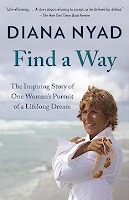
Find a Way by Diana Nyad

Find a Way by Diana Nyad is a great work of nonfiction about her life and 2013 swim from Cuba to Florida at the age of sixty-four. The trip covered 110.86 miles and took her 52 hours, 54 minutes, and 18 seconds. 

It’s a remarkable story of achievement and determination, with it Nyad’s fifth attempt to make the crossing. The first was in 1978, followed by some thirty years of no competitive swimming—when she instead worked as a journalist and broadcaster, reporting around the globe for Wide World of Sports—and then subsequent attempts in 2011 (two that year) and 2012 before the successful 2013 swim.

The book is a great personal story, one that covers the sexual abuse she received as a teenager at the hands of a swim coach, one who was never formally punished. She had a fascinating family, with a caring mother, and a charismatic, deceitful, and violent father. Nyad wrote about the eight years she spent with her mom after she was diagnosed with Alzheimer's before her 2007 death. Nyad turned 60 two years after that, and then decided to train again for another Cuba to Florida attempt.

The book features many great quotes, including from Nyad that life is not what we expect, and how she strove to tackle every day with no regrets, so that each could “not be done a fingernail better.” Also noted as important to Nyad is a Mary Oliver quote "tell me, what is it you plan to do with your one wild and precious life?"

It’s a great story of teamwork and pain endured, including the box jellyfish that were a constant source of life-threatening danger, and the reason for multiple failed attempts. The stories of stings, and then preventative measures taken to try to avoid them were remarkable. It was inspiring stuff from Nyad and a really good book.

The Lemon by S.E. Boyd

The Lemon by S.E. Boyd is a fun and entertaining novel written by Kevin AlexanderJoe Keohane, and Alessandra Lusardi, with S.E. Boyd a made-up author from the three writers of the book. 

They tell a story that starts with the death of Joe Doe, a beloved food travel show host, and then details the coverup of the more unseemly aspects of the hotel room death, including the actions of local Irish bellhop Smilin' Charlie McCree, and Doe's famous chef friend Paolo Cabrini. Two other great character in the book are Nia Greene, Doe's agent/business partner and Katie Horatio, a website writer who fabricates a connection with Doe and parlays it into an entirely new career.

It's definitely a fun read, one highly recommended.


Wednesday, May 31, 2023

Lessons in Chemistry by Bonnie Garmus

Lessons in Chemistry by Bonnie Garmus is an interesting and fun novel set in the 1950s, covering well what women had to deal with at the hands of men. There's a tremendous amount of heart and humor in the book and a compelling main character, and almost equally interesting dog of hers, Six-Thirty. It's really a nice read.


The Wager by David Grann

The Wager by David Grann is a good work of nonfiction subtitled A Tale of Shipwreck, Mutiny and Murder. Grann recounts the story of the British ship Wager that left England during a conflict with Spain in 1740, going after a Spanish ship filled with treasure. 

The ship made it from the Atlantic to the Pacific, going around Cape Horn at the bottom of South America through the Drake Passage, spending more than a month in the rough waters where the two oceans meet, and losing, many to scurvy, around 100 of the original 250 sailors. The Wager then went north off the Chilean coast of Patagonia and ran onto rocks in the bay Gulfo de Penas. The sailors got off the ship and took small boats to what would become known as Wager Island. Grann recounts what happened next, with some of the party leaving to create a splinter group, making alliances with some and abandoning others. The Wager's captain, David Cheap, couldn't control the men and then shot and killed a man under his command after they had been on the island for 41 days. While stranded, the men came across people from the KawĂ©sqar, an indigenousness group of a few thousand people. 

A group then said they were leaving for England through the Strait of Magellan back to the Atlantic, this after Cheap said he intended to continue with the plan to attack the Spanish on the Pacific coast. The men left and Cheap along with 19 others, not all of whom were still following him, stayed behind. 81 men went through the Strait of Magellan, then north. After three and a half months, and 283 days after the ship had last been reported seen, 29 men reached Brazil, the port of Rio Grande. Then six months later, 3 survivors appeared in Chile, leveling accusations against the first men who appeared in Brazil.

Some of the party returned to England, and then, two years later, Captain David Cheap appeared in England with two others. He and his companions had been captured by the Spanish and held for some time before being allowed to return home. Accusations and counter-accusations were hurled between the men, leading to an eventual military trial. Also interesting from the story was that Commodore George Anson of the group of six ships the Wager a part of ultimately was successful in his mission to plunder Spanish riches, garnering the equivalent of some $80M in today's dollars before his return to England, but with the cost the lives of some 1,300 of the 2,000 men under his command.

Sunday, April 30, 2023

It's All Relative by A.J. Jacobs

It's All Relative by A.J. Jacobs is an entertaining book subtitled Adventures Up and Down the World's Family Tree with Jacobs telling the story of planning the Global Family Reunion event in 2015. 

The book is all about family trees, looking at the history in one's family, seeing how we're connected with one another, what it means to be in a family, and how it influences who we are. It's a whimsical and interesting look at Jacobs with the Global Family Reunion pursuing the lofty goal of trying to shed tribalism, to move towards more of a shared connectedness between people. 


Tomorrow, and Tomorrow, and Tomorrow by Gabrielle Zevin

Tomorrow, and Tomorrow, and Tomorrow by Gabrielle Zevin is a novel that chronicles the lives of video game designers Sadie Green and Sam Masur, along with their friend and colleague Marx Watanabe. 

It's a story that spans across the years and is a compelling and well-written look at the three, their lives, relationships, and the worlds they create through video games.

Tuesday, March 28, 2023

The Escape Artist by Jonathan Freedland

The Escape Artist by Jonathan Freedland is a powerful work of nonfiction subtitled The Man Who Broke Out of Auschwitz to Warn the World. It tells the story of Rudolf (Rudi) Vrba, one of only a handful of Jews to escape from the concentration camp. Vrba was born Walter Rosenberg, keeping the name he assumed after escaping, and the story preserves the memory of the atrocities by the Germans as they attempted to exterminate an entire race of people. A book like this is an important record of what can happen when evil is left unchecked.

Vrba was born in Czechoslovakia, a country created six years prior to his birth in 1924. In 1939, his land of Slovakia declared itself independent, but really was a creation of Germany. Once that happened, Vrba’s rights were gradually taken away due to his Jewish heritage and in February 1942 at seventeen, he received an order to report to be resettled in Poland. This was part of a German plan that started with taking the assets of Jews, depriving them of ways to make a living, then declaring them a drain on society that had to be removed. Vrba tried to flee, but was captured, and then packed onto one of the trains of people leaving for Poland. He arrived at Auschwitz late June 1942, later learning that of the 600 men on the first transport out of Slovakia, only 10 survived.

The camp was both a killing ground and profit center, with Jews encouraged to bring their belongings, and then Germans pilfering the items, and either killing immediately or working the Jews to their deaths. It was noted as a point of ongoing discussion how many to instantly kill in the showers with Zyklon B gas and how many to keep alive and put to labor. Four out of every five Jewish arrivals at Auschwitz were selected for immediate death. Gold teeth were pulled out and prisoners were told to tie their shoelaces together, so the pairs of shoes could go to new German owners. The story is also told of the 5,000 Czech Jews who came into Auschwitz Camp B and lived as if they really were just resettled into a community, and the Germans brought them in with orders for them to be like that for six months and then killed. It was all done as a ruse in case they had to show outsiders a resettlement camp.

Vrba decided to make a mental record of what he saw, so he could escape and warn others, disrupting the killing machine. His notion was that if people knew of the extermination occurring at Auschwitz, either the Germans would be stopped, or at least the Jews would make it more difficult on the Germans, allowing some to escape. The concept was their assembly line of death worked so efficiently due to the lies told to the Jews. He wanted specifically to warn hundreds of thousands of Hungarian Jews who were slated to be sent to their deaths, with Vrba seeing an extension being built onto the railway line to make their slaughter more efficient. 

He and Fred Wetzler got out in April 1944, the first Jews ever to escape the concentration camp, with two more escaping several months later. When they got to freedom, they sat down for long interviews, with the account of those becoming known as the Vrba-Wetzler Report. It gave an itemized estimate of 1,765,000 Jews gassed to death at the camp between April 1942 and April 1944. The report had a circuitous path, it made it to some people, others pledged to give it to others and didn't, others saw it and pledged to act and didn't, others saw it and thought it so unspeakably horrible it must not be true. People often simply didn't want to believe possible what the Germans called The Final Solution to the Jewish Question. While this was occurring, 10,000-15,000 Hungarian Jews were daily arriving at the camp, with over 90% of them killed immediately. Some in leadership of the Hungarian Jew population that Rudi had wanted to warn were busy saving some of the people, but only those close to them. Even with this, it can definitely be said that the report that came out of Vrba and Wetzler was largely responsible for the saving of 200,000 Jews in Budapest.

Some six million Jews were killed by Germany and Freedland writes in the book about seeing Vrba in the nine-hour documentary, Shoah. He settled after the war in communist Czechoslovakia, then escaped to the West, eventually winding up in Vancouver, Canada. Vrba wasn't always afforded the respect he deserved, in part because he railed about those in Jewish leadership who let him down. He made the point that the machine relied on people acting like sheep, letting themselves be led to their slaughter. While it’s largely true that Jews didn't know they were going to be killed, Freedland notes that those not young simply might not have believed it possible, even if they knew, people could be in denial. Facts are one thing, belief from those facts can be another. Vrba also felt while at Auschwitz that if the outside world had full knowledge of what was occurring, the Allies would stop the killing. Reference is made to the Martin Gilbert book Auschwitz and the Allies that Vrba was interviewed for and in actuality, foreign powers did kind of know about the extermination of the Jewish people and didn’t concentrate on stopping it. Reasons ranged from whether a focused effort to stop the extermination would distract from the overall war effort to whether people would get behind saving Jews. It’s a solid and important book and Freedland in the beginning notes that the Vrba should be remembered for what he did, similar to how Vrba felt it vital that people know what the Nazis were doing to the Jewish people.

Sunday, March 26, 2023

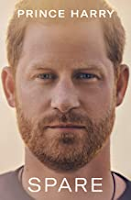
Spare by Prince Harry

Spare by Prince Harry is an autobiography that’s both compelling and well-crafted, with Harry writing it along with J.R. Moehringer, ghost writer of Open by Andre Agassi and Shoe Dog by Phil Knight. It’s a very personal story that covers Harry’s life and the things that caused him to not be an active part of the royal family.

The British press would hound Harry and anyone associated with him, and palace advisors would leave him to fend for himself, with him being told about lies said of him to "ignore it and it will go away." The press operated at time on the basis that even if something was not true, the value they would derive from printing it outweighed the potential negative in libel suits. Harry also wrote about how as he looked at pictures from inside the Paris tunnel where his mom died when he was twelve, he saw how her dying face was lit up by flashes from press photographers. He also notes that one of the worst papers was News of the World, owned by Rupert Murdoch.

Harry's father and brother certainly don't come across positively in the book, but less for them being malicious, and more for them simply going along with what royal advisors wanted. One anecdote Harry tells is how when he got injured in military exercises just prior to joining the Army, the palace reported he got hurt playing rugby, so the press said he afraid to serve his country. It was interesting to read about his military service, with him first directing people toward enemy targets and then becoming a helicopter pilot. Also covered is his charity work, including for soldiers injured in combat (which led to the formation of the Invictus Games), and for people in Africa with AIDS. It was great content about Harry's love of Botswana, flying into Maun and spending time in the Okavango Delta in the Kalahari Desert. He would sit around the campfire, often with his friends Teej and Mike who owned a film production company, with the wilds of Africa just outside that circle. He refers to Botswana as being the most sparsely populated nation on earth, with 40% of the land given over to nature.

The latter part of the book is about his time with his now wife. The press was frequently racist toward Meghan, harassing she and her family and referring to her as being “from Compton, home of gangsters.” Things she was doing that at worst were cultural misunderstandings were blown up to be character flaws and conflicts. Palace decision-makers didn't back her in the press regarding things that she was criticized for, often when the same palace advisors had given her the go-ahead or direction, on things to do or wear. They also wouldn't officially contradict false statements, they just let them sit out there, perhaps in part because if she was getting all the bad press, it wasn’t being directed towards Charles or William. Harry and Meghan were in British Columbia, Canada when their security was pulled in March 2020, leaving them not knowing where they could go and still be safe. Tyler Perry offered them use of his empty house in Los Angeles, saying that he was doing it because of the love his late mother felt towards Harry’s late mother, Diana. There’s much in the book that’s a shame with the deterioration of Harry’s relationship with Charles and William, much that’s outraging with how the press and the palace advisors treated he and Meghan, and much that's interesting and really good storytelling.

Sunday, February 26, 2023

Bad City by Paul Pringle

Bad City by Paul Pringle is a solid work of nonfiction subtitled Peril and Power in the City of Angels. Pringle is a reporter for the Los Angeles Times and the book comes out of a 2019 Pulitzer Prize winning investigation for the Times into sexual abuse by Dr. George Tyndall at the University of Southern California, which came on the heels of reporting that Pringle did into Dr. Carmen Puliafito, Dean of the USC Medical School. 

The majority of Bad City covers Puliafito, who while he was Dean, supplied drugs to a woman some four decades younger that he met when she was working as a prostitute. She later overdosed in a hotel room with Puliafito, an event that was largely swept under the rug by Pasadena police, ignored by USC leadership, and had publishing roadblocks put in front of it by L.A. Times editors. It's a good account of the influence of power, and dogged reporting by Pringle and his team to try to overcome those influences and bring the story public.

Saturday, February 18, 2023

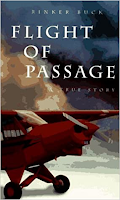
Flight of Passage by Rinker Buck

Flight of Passage by Rinker Buck is a solid book, and the first from the writer of The Oregon Trail and Life on the Mississippi. Published in 1997, it chronicles the flight across the U.S. done by 15-year-old Rinker and his 17-year-old brother Kern Buck, a trip many reporters said was the youngest cross-country trip flown.

Kern was the primary pilot and Rinker the navigator and they in 1996 flew an 85-horsepower Piper Cub from New Jersey to California without a radio. The week-long trip went through Pennsylvania, Ohio, Indiana, Arkansas, Texas, New Mexico, and Arizona before they reached their Orange County destination and the boys' Uncle Jimmy who lived there. 

It's an interesting read about the journey, done with the encouragement of their father Tom Buck, a barnstorming air-show pilot for decades who lost a leg in a plane crash before the birth of the brothers. The book includes great content on the trip, the confidence that grew in the boys through it, including from flying the Guadalupe Pass through the Rockies, and the characters met along the way. It's a really good tale of a time in America and the completion of a fairly herculean task. Buck also details well the dynamic between he and Kern and how they interacted with their larger-than-life father.

Sunday, January 15, 2023

River of the Gods by Candice Millard

River of the Gods by Candice Millard is a solid book subtitled Genius, Courage, and Betrayal in the Search for the Source of the Nile. The book tells the story of Richard Burton and John Speke as the two British explorers searched in Africa to find what feeds the longest river in the world, and then to prove their dissenting opinions.

There was a legend that the source of the Nile was the Mountains of the Moon, a series of peaks, and the Nile has a basin that spans more than a million square miles, and has enabled survival for ancient civilizations. It was known that the Nile made up of both the Blue and White branches, the mystery was the source of the White Nile. 

Burton was the leader of the 1856 first expedition to find the source. He was a master swordsman, impersonated a Muslim to go to Mecca, and was adept at languages, later to become known for his translations. Speke joined the expedition as a surveyor and the men were in Somaliland when their expedition was attacked and men killed. Speke was taken, but managed to escape while suffering eleven stab wounds. Burton was stabbed through his jaw, and the effort abandoned and the men returned home to England. Speke felt that the expedition was not prepared and it Burton's fault.

Despite this start to their relationship, the two set off on a second trip to Africa in search of the source of the White Nile. Joining the expedition was an African named Sidi Mubarak Bombay, who would prove important to their efforts, particularly Speke's. The expedition traveled from the Indian Ocean through East Africa and six months after they left the coast, Burton was almost completely paralyzed with malaria. Burton recovered somewhat and the two men came across Lake Tanganyika, the longest and second deepest freshwater lake in the world. They were the first Europeans to reach the lake, which Arabs had been to for decades. Burton believed the White Nile flowed out of Lake Tanganyika, but Speke had heard of another lake and wanted to go in search of it. Burton agreed to let Speke go without him and Speke and Bombay traveled on to Lake Nyanza, which covers nearly 27,000 square miles, more than twice the size of Lake Tanganyika. Speke immediately felt he had found the source of the Nile, and without his expedition lead, but Burton was skeptical of Speke's claim.

Speke returned on his own to England and immediately made the case for Lake Nyanza, which he renamed Lake Victoria, as the source of the White Nile and painted a picture of Burton as bedridden and unable to make the journey there. Speke received funding from the Royal Geographic Society to return to Africa and hopefully settle the matter of which lake fed the White Nile, with Speke now leading his own expedition. Speke returned to Zanzibar in 1860 and then he and the expedition got to Lake Nyanza, and a waterfall roughly sixteen feet high and nearly a thousand feet wide, with water from the lake going into the river. He didn't complete navigation of the lake or do anything else to definitely prove it the source, but he felt he had seen enough. 

Speke returned to England in 1963 and wasn't very good at proving his assertation about Lake Nyanza over Lake Tanganyika. He didn't have enough evidence to back his claim, and Burton was a much better writer, providing detail that Speke did not. Burton and Speke were to debate the source of the Nile in a Royal Geographic Society talk on Sept 16, 1864, but Speke shot himself prior to it. Nearly a decade after Speke's death, someone else confirmed what Speke had said, Lake Nyanza was the source of the White Nile. It was later found that while Lake Nyanza the principal source, the lake is fed by many smaller rivers and streams, the largest of which is the Kagera River. Speke ultimately was proven correct, but history remembers Burton more, with his books, poems, and translations providing a greater measure of fame than his exploration.

Sooley by John Grisham

Sooley by John Grisham departs from Grisham's most common area of legal thrillers, with this novel tracing the path of Samuel Sooleymon, leaving war-torn South Sudan at 17 to play basketball in the United States.  

It's an entertaining and fast read that tells both a sports story and one about the brutal conflict that the main character left behind in Africa. 

Wednesday, December 28, 2022

Life on the Mississippi by Rinker Buck

Life on the Mississippi by Rinker Buck is an excellent travelogue of sorts, in the same vein of his book The Oregon Trail. In this latest effort, Buck chronicles a 2,000 trip down the Ohio and then into the Mississippi River in a wooden flatboat, the Patience. It's a great read about the people and history of the region joined with the experience Buck had traveling down the rivers.

Flatboats were a common thing in the early 1800s and Buck takes one from the town of Elizabeth, just above Pittsburgh, to New Orleans. He starts out a neophyte and learns how to boat on the river along with the huge commercial vessels, particularly the long barge strings above New Orleans. The book is a great story about an idea that's seen through, and Buck makes the comment that a river journey is an exploration of character. He at times travelled solo and at times with others and he and his crew solve problems along they way. They navigate the rivers, deal with pop-up storms that emerge without warning, force a beaching and then get back in the water, and find fuel when there's many stretches with none by the water. 

Buck also writes about the communities, places like New Madrid, Missouri and Natchez, Mississippi. There were such interesting characters he met along the way, "river rats" who grew up on the Ohio or Mississippi. The rivers, especially the Mississippi, are commercial traffic heavy and to avoid a collision, he deliberated beached the Patience and  relied on the wash from a tugboat wake to get him off the sandbar. 

There's a lot about how the history Buck sees isn't always in the line with the idealized history we like to think of. He chronicles the slave trade and Indian Removal Act of 1830 and the devastating impact it had on lives. Buck also writes about his mother, who passed away not much before he started the trip, and how he would drop her off at the supermarket once weekly for her to do her shopping for an hour. It's a personal and interesting story that's told really well.

Tuesday, December 27, 2022

The Light We Carry by Michelle Obama

The Light We Carry by Michelle Obama is a solid follow up to her book Becoming from 2018. The first is more of an autobiography and this recent effort, subtitled Overcoming in Uncertain Times, notes that it contains habits, practices, attitudes, and beliefs; a series of reflection on things Obama feels to be important and leans on in her life. It's excellent and the chapters that stood out to me as particularly noteworthy are the following:

The Power of Small - Try not to get overwhelmed with the enormity of situations, focus on little things. The example given is knitting, how in doing it, Obama is able to settle an anxious mind. She's putting small next to big. Do something where you can claim a small victory and feel a sense of completion. Go from "it's all too much" to "I've got this." 

Starting Kind - Obama tells the story of her friend who each morning looks at himself in the mirror and says "Heeey, Buddy!" The idea is to take a supportive approach to a day, and it can be extrapolated out to a situation or even a life. She also notes that when a kid walks into a room, they're looking to adults to see if their faces light up when they see them. While we should do that for kids, we can also do that for ourselves. 

Am I seen? - It's hard to go through life feeling different than others, like you don't belong where you are. She notes that it's hard to dream about what we can't see. When you're an "only" in a setting, the only person who is like you, it's hard to feel like you belong. 

My kitchen table - It's important to try to make connections with other people, many of us are lonely. People are missing the sense of belonging with other people. We have to open ourselves up and take a risk to connect with others. She notes telling her daughters "don't do life alone." 

Meet my mom - There's great content in the chapter that stems from Obama's mother, with various maxims she's learned about parenting: 1. Teach your kids to wake themselves up. 2. It isn't about you. Good parents are always working to put themselves out of business. 3. Know what's truly precious. 4. Parent the child you've got. 5. Come home. We will always like you here. 

The armor we wear - Preparation can be an armor. Preparedness becomes a hedge against panic. And panic is what will lead you to disaster. There's also armor which insulates yourself from situations and can be exhausting to keep up, as it prevents you from being your true self. 

Going high - We can consciously choose to lift the level of discourse in a situation, to not let ourselves be pulled down in the muck with others who want us there. Another way to describe it is "tell the truth, do your best by others, keep perspective, stay tough." Obama notes that going high is about doing what it takes to make your work count and your voice heard, "despite the despites."

Saturday, December 03, 2022

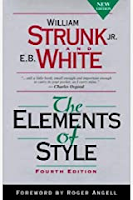
The Elements of Style by William Strunk Jr. and E.B. White

The Elements of Style by William Strunk Jr. and E.B. White was first published in 1959 and over 10 million copies have been sold of this short book with rules of writing. Strunk was a professor of White's and self-published The Elements of Style in 1919. White forty years later expanded on Strunk's rules for the new book.

It's got a lot in less than 90 pages, with the things that stood out noted below:

Form the possessive singular of nouns by adding 's - this is true even if the name ends in s, so "Charles's friend" is correct.

To form the contraction for "it is," write "it's."

In a series of three or more terms with a single conjunction, use a comma after each term except the last - this is a serial, or Oxford, comma.

Do not join independent clauses with a comma - if clauses are grammatically complete, they should be separated by either a semicolon or period. 

Use the active voice. Put statements in positive form.

Use definite, specific, concrete language. Omit needless words. Be clear.

The number of the subject determines the number of the verb - don't combine singular and plural.

A participial phrase at the beginning of a sentence must refer to the grammatical subject.

Express coordinate ideas in similar form - this is the principle of parallel construction.

Place the emphatic words of a sentence at the end.

Avoid split infinitives - write "to inquire diligently" rather than "to diligently inquire."

Write with nouns and verbs, not with adjectives and adverbs (verbs that have "ly" added to the end).

Wednesday, November 30, 2022

The Mosquito Bowl by Buzz Bissinger

The Mosquito Bowl by Buzz Bissinger is a solid book subtitled A Game of Life and Death in World War II. Bissinger chronicles how the 4th and 29th Marine Regiments of the 6th Marine Division played football against each other on Christmas Eve in 1944, with 15 of the 65 players killed while taking Okinawa in 1945.  

The game came about as there so many great college football players in the two regiments. The Marines who played on Guadalcanal included a great roster of college football talent, drawing from former All-Americans, captains from Wisconsin, Brown, and Notre Dame, and nearly twenty who would be drafted or play in the NFL. 

The subsequent Battle of Okinawa was one of the bloodiest of the 20th century, with roughly 3,000 people (American and Japanese troops along with Japanese citizens) dying every day during the eighty-two-day campaign that began on April 1, 1945. The 15 killed at Okinawa was by far the largest number of American athletes to be killed in a single battle, and Bissinger notes in the preface that his father part of the Okinawa invasion, with him also in the 4th Marine Regiment. 

Bissinger chronicles in the book how the loss of American life at Okinawa could have been lessened if better command decisions were made. Also, he covers how the Japanese were so willing to die, either soldiers in battle or civilians killing themselves and their families to avoid what their government told them would be torture at the hands of American troops. Additionally noted was the numerous kamikaze attacks by Japanese pilots, suicide missions against US ships.

It's a solid book and some of the fallen Marines written about were John Jackson McLaughry, David Schreiner, Tony Butkovich, Bob Bauman, and George Murphy. Of these men, the only one of them to survive the war was McLaughry, who died in 2007 at the age of 90.

Sea of Tranquility by Emily St. John Mandel

Sea of Tranquility by Emily St. John Mandel is the sixth novel from Mandel, with two of the prior ones Station Eleven and The Glass Hotel

This latest work is a time-travel novel, cutting across centuries with various characters that eventually connect together and while I enjoyed The Glass Hotel more, I did like how Sea of Tranquility includes reference to some of the same characters as from that book.


Saturday, October 29, 2022

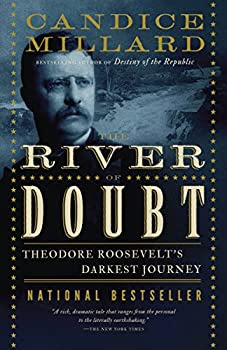
The River of Doubt by Candice Millard

The River of Doubt by Candice Millard is a solid book subtitled Theodore Roosevelt's Darkest Journey. Millard chronicles well the ex-Presidents 1914 voyage down an uncharted tributary of the Amazon River and it was a remarkable tale of a harrowing journey.

The co-commander of the expedition was Colonel Candido Rondon, a man Roosevelt respected greatly, and a hero to Brazilians. The fierce determination of Roosevelt to the mission of the expedition at the cost of his personal safety was striking, along with how dangerous it was. They spent months in the wilderness, dealing with disease and near-starvation. They continually lost their canoes, both ones they brought and ones they made, replacing those lost or not suitable for use on the perilous waters. 

Roosevelt is a fascinating character. He was an enfeebled child, and built his body up through determination, action, and hard work, things that became a constant for through the years. Roosevelt undertook the Amazon journey in part to try to get over a failed presidential bid, with the loss to Woodrow Wilson leaving him doubting himself. He went to Brazil with his son, Kermit, and the expedition was wildly optimistic starting out, with provisions way too heavy and selected for comfort and enjoyment. 

The actual route taken was not the original plan of going down a well-known river. It was Brazil's minister of foreign affairs who proposed the path down the unknown river, knowing that was the sort of thing that would appeal greatly to both Roosevelt and Rondon. Except for the indigenousness tribes, only a few people in history had ever reached the headwaters of what would become named the River of Doubt. The expedition faced grave danger from the local tribes, and Rondon made a point of trying to have relationships with them, even if that meant he or his men be killed. He refused to let his men retaliate against the Indians as he felt forming these relations even more important than exploration. The men often had to portage around rapids, cutting through the jungle and carrying everything. Then the rapids they did try to pass through could be exceedingly dangerous, and led to to the death of one of their crew. Another of their crew killed a fellow member, and then was almost certainly killed by the Cinta Larga Indians as he abandoned the expedition. 

When Roosevelt was on the brink of death from malaria and a bacterial infection as the result of a gash on his leg and considering ending his life to ease the burden on the expedition, it was his desire to see Kermit, one of his sons, survive the voyage that kept him going. They spent six weeks on the river before seeing signs of non-Indian life, they came across- rubber tappers, those who took from the Amazonian rubber tree. Roosevelt lost 55 pounds on the journey, a quarter of his body weight. 

The Winners by Fredrik Backman

The Winners by Fredrik Backman is a really good novel that closes out Backman's three-book series that began with Beartown and then Us Against You. This latest book by Backman provides an excellent capstone to the story on the people in a remote, hockey-mad Swedish community and its rivalry with the neighboring town.

Backman seems to have had the entire story in mind throughout writing the books, as some details in the third hearken back to things in the earlier novels. The Winners is a satisfying and poignant read that covers well struggle, pain, and connection.

Heat 2 by Michael Mann and Meg Gardiner

Heat 2 by Michael Mann and Meg Gardiner is an entertaining novel that follows up on the 1995 movie directed by Mann and starring Al Pacino, Robert De Niro, and Val Kilmer. The book covers years before and after the movie, with backstories on the main characters and showing what occurred following the original story.

Along with being a good book, it's an interesting concept, with it a book follow up to a movie, one that's both a prequel and sequel, and the plan is to turn it into a film.

Saturday, September 17, 2022

Serious Face by Jon Mooallem

Serious Face by Jon Mooallem is an excellent book of essays by someone whose writing I enjoy quite a bit. Mooallem wrote Wild Ones and This is Chance and provides in his latest book thirteen different pieces of writing that he's done, some of which I had some before and some new to me.

Mooallem's writing strikes me as interesting and profound, with his stories often providing unexpected twists and a different look at things than expected. In Serious Face, stories he tells include the following...

"We Have Fire Everywhere" about the fire in Paradise, CA and people fleeing it.

"Why These Instead of Others?" about a twenty-something Mooallem being in Glacier Bay National Park in Alaska and his friend needing Coast Guard rescue after a tree fell on him, causing near-fatal injuries.

"A House at the End of the World" about B.J. Miller, who started in San Francisco the Zen Hospice Project for people with terminal illnesses.

"The Outsiders" about two men helping people as they leave prison, picking them up as part of the Ride Home Program of the Anti-Recidivism Coalition and easing their transition from jail. 

Tracy Flick Can't Win by Tom Perrotta

Tracy Flick Can't Win by Tom Perrotta is an enjoyable novel by the writer of Election, published in 1998 and turned into the Reese Witherspoon-starring movie of the same name. In this decades-later follow up, Perrotta brings us back to Tracy Flick's life and her aspirations. The book is written in an interesting style, with chapters jumping between characters and points of view in the writing and comes to an interesting close. It's a fast and fun read, especially for those familiar with the character of Track Flick that Perrotta wrote some thirty years ago.